
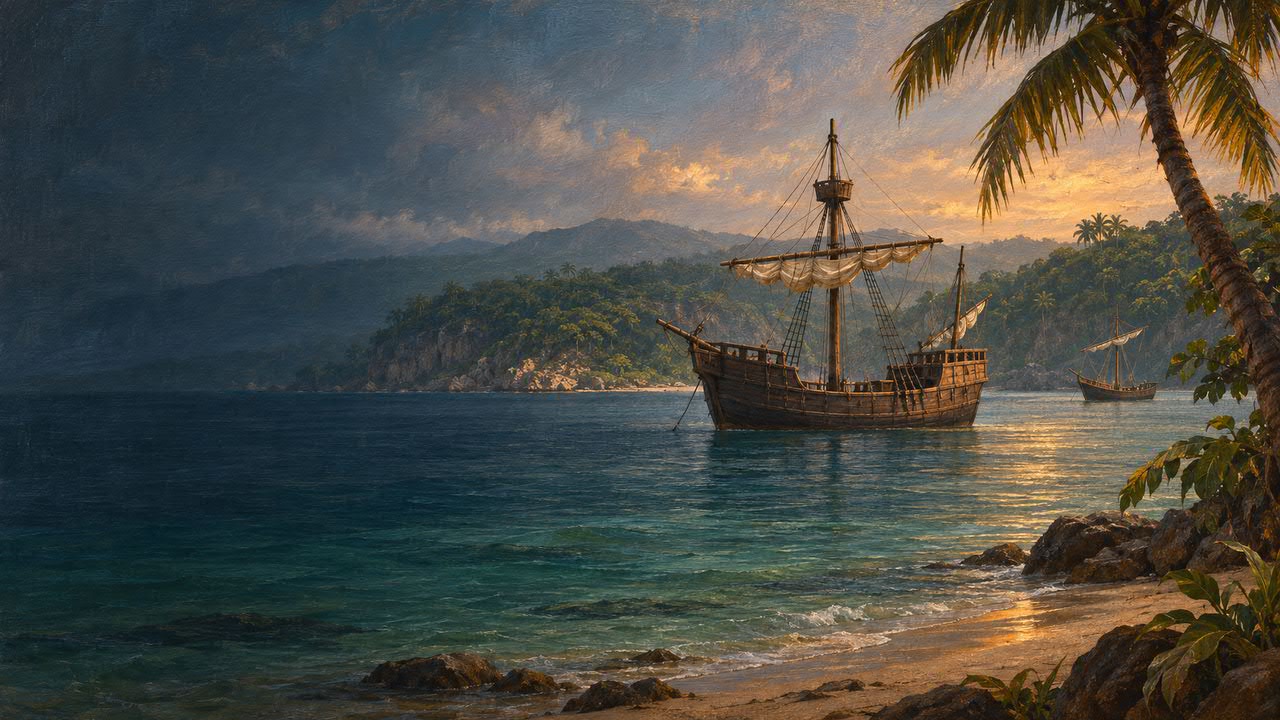
Castilian expansion: from the Caribbean to the Pacific
1492–1522
From Columbus’s crossings and Castilian settlements in the Caribbean to Taíno resistance, Balboa’s crossing of the isthmus and the Magellan–Elcano circumnavigation.
Chapters
- Across the Atlantic 2 events
Columbus sails west in 1492 and reaches an island in the Bahamas. The precise location of the landfall remains disputed.
- Settlements and resistance 7 events
The second voyage brings settlers to the Caribbean. As the Iberian crowns divide their claims, Castilian expansion brings forced labour, warfare and Indigenous resistance.
- Towards the Pacific 4 events
Balboa crosses the isthmus to the Pacific. Expeditions then explore the shores of Yucatán and the Gulf of Mexico. The voyage begun under Magellan ends under Elcano.
Events of the story
This list is the film in text: the same events, in the same order and chapters as on the map. Each event has its sources.
Chapter 1 of 3 · Across the Atlantic 2 events
- First voyage of Christopher Columbus3 August 1492 – 15 March 1493 · Western and Central EuropeIn the short version
Columbus’s three ships, fitted out by the Crown of Castile to find a western route to Asia, crossed the Atlantic and reached the Bahamas, Cuba and Hispaniola.
Sources (5)
- Wikipedia (English): Voyages of Christopher Columbus
- Wikipedia (Russian): Первая экспедиция Христофора Колумба
- Wikipedia (Russian): Открытие Америки
- Morison S. E. Admiral of the Ocean Sea: A Life of Christopher Columbus. — Boston: Little, Brown and Company, 1942.
- Wikidata: Q3771259
Columbus’s sailors sighted the island of Guanahani in the Bahamas; Columbus went ashore, named it San Salvador and claimed it for the Catholic Monarchs. The voyage opened a period of sustained contact across the Atlantic.
Sources (7)
- Wikipedia (English): Voyages of Christopher Columbus
- Wikipedia (Russian): Первая экспедиция Христофора Колумба
- Wikipedia (Russian): Открытие Америки
- Morison S. E. Admiral of the Ocean Sea: A Life of Christopher Columbus. — Boston: Little, Brown and Company, 1942.
- Fordham University, Internet History Sourcebooks: Christopher Columbus, Extracts from Journal, 11–12 October 1492
- Parks Canada: Culture and history of L’Anse aux Meadows
- Wikidata: Q221474
Chapter 2 of 3 · Settlements and resistance 7 events
- Second voyage of Christopher Columbus25 September 1493 – 11 June 1496 · Latin America
Columbus returned to the Caribbean with 17 ships and well over a thousand settlers, discovered the Lesser Antilles, Puerto Rico and Jamaica, and founded La Isabela on Hispaniola, the first Spanish town in the Americas.
Sources (6)
- Wikipedia (English): Voyages of Christopher Columbus
- Wikipedia (Russian): Вторая экспедиция Христофора Колумба
- Wikipedia (Spanish): Segundo viaje de Colón
- Morison S. E. Admiral of the Ocean Sea: A Life of Christopher Columbus. — Boston: Little, Brown and Company, 1942.
- Morison S. E. The European Discovery of America: The Southern Voyages, A.D. 1492–1616. — New York: Oxford University Press, 1974.
- Wikidata: Q6123903
- La Isabela, the first Castilian town in the Americasbetween December 1493 and January 1494 – 1498 · Latin AmericaIn the short version
Around the turn of 1494 the colonists of Columbus’s second voyage founded La Isabela on the north coast of Hispaniola, the first Castilian town in the Americas. Hunger, disease, revolt and conflict with the Taíno undermined it; from 1496 its people moved to Santo Domingo, and by 1498 the town was abandoned.
Sources (6)
- Wikipedia (English): La Isabela
- Wikipedia (Russian): Ла-Исабела
- Las Casas B. de. Historia de las Indias. T. II. — Madrid, 1875. — Lib. I, cap. 88, 92, CXI, CXIII.
- Fernández de Oviedo G. Historia general y natural de las Indias. T. I. — Madrid, 1851. — Lib. II, cap. XII–XIII.
- Thibodeau A. M., Killick D. J., Ruiz J., Chesley J. T., Deagan K., Cruxent J. M., Lyman W. The strange case of the earliest silver extraction by European colonists in the New World // Proceedings of the National Academy of Sciences. — 2007. — Vol. 104, no. 9. — P. 3663–3666.
- Florida Museum of Natural History: Historical Archaeology collections — Latin America
Castile and Portugal divided the world outside Europe along a meridian 370 leagues west of the Cape Verde Islands: lands to the west went to Castile, those to the east to Portugal.
Sources (4)
- Wikipedia (English): Treaty of Tordesillas
- Wikipedia (Russian): Тордесильясский договор
- Davenport F. G. (ed.) European Treaties bearing on the History of the United States and its Dependencies to 1648. — Washington: Carnegie Institution of Washington, 1917.
- Wikidata: Q180897
- Bartholomew Columbus founds Santo Domingo on the east bank of the Ozamabetween 1496 and 1498 · Latin America
On the Admiral’s instructions to find a southern harbour near the gold mines, Bartholomew Columbus built a fort and settlement at the mouth of the Ozama, on its eastern bank — the beginning of Santo Domingo, which replaced La Isabela as the centre of the colony. No founding document survives, and the year is disputed between 1496 and 1498.
Sources (6)
- Wikipedia (English): Santo Domingo
- Wikipedia (Russian): Санто-Доминго
- Wikipedia (Russian): Колониальный город Санто-Доминго
- Las Casas B. de. Historia de las Indias. T. II. — Madrid, 1875. — Lib. I, cap. CXI, CXIII.
- Fernández de Oviedo G. Historia general y natural de las Indias. T. I. — Madrid, 1851. — Lib. II, cap. XIII.
- «No existe un documento oficial sobre el día de la fundación de Santo Domingo de Guzmán» (Acento, 8 August 2023; lecture by José G. Guerrero Sánchez, Museo Nacional de Historia y Geografía)
- Juan Ponce de León begins the Castilian settlement of San Juan (Puerto Rico) and founds Caparra1508–1509 · Latin America
Sent by Governor Ovando, Juan Ponce de León crossed from Hispaniola to the island its Taíno inhabitants called Borikén, was received by the paramount cacique Agüeybaná and began a Castilian settlement at Caparra near the north coast. Gold washing with Taíno labour assigned to the settlers followed, and with it the grievances that led to the uprising of 1511.
Sources (5)
- Wikipedia (English): Juan Ponce de León
- Wikipedia (English): History of Puerto Rico
- Wikipedia (Russian): Пуэрто-Рико
- Las Casas B. de. Historia de las Indias. T. III. — Madrid, 1875. — Lib. II, cap. XLVI, XLIX, LI, LV.
- Fernández de Oviedo G. Historia general y natural de las Indias. T. I. — Madrid, 1851. — Lib. XVI, cap. II–V.
In 1511 Diego Velázquez, acting for Governor Diego Columbus, crossed from Hispaniola with some 300 men, founded Baracoa and crushed the resistance led by the exiled cacique Hatuey, who was burned alive. Campaigns with Pánfilo de Narváez carried Castilian rule westwards; by April 1514 there were four Spanish towns, and Taíno communities in occupied districts had been assigned to settlers in encomiendas.
Sources (8)
- Wikipedia (English): Diego Velázquez de Cuéllar
- Wikipedia (English): Hatuey
- Wikipedia (Russian): Веласкес де Куэльяр, Диего
- Wikipedia (Russian): Атуэй
- Las Casas B. de. Historia de las Indias. T. III–IV. — Madrid, 1875–1876. — Lib. III, cap. XXI, 25–32.
- Las Casas B. de. Brevísima relación de la destruición de las Indias. — Sevilla, 1552. — «De la isla de Cuba».
- Wright I. A. The Early History of Cuba, 1492–1586. — New York: Macmillan, 1916. — Ch. II–V, pp. 23–69.
- Fernández de Oviedo G. Historia general y natural de las Indias. T. I. — Madrid, 1851. — Lib. XVII, cap. III.
- Taíno uprising in San Juan (Puerto Rico) and its suppression1511 · Latin AmericaIn the short version
Early in 1511 caciques of San Juan, led by Agüeybaná II, rose against forced labour for the settlers: Cristóbal de Sotomayor and, by the chroniclers’ count, about eighty Spaniards were killed. Ponce de León counterattacked and won some engagements in 1511, but resistance went on for years.
Sources (5)
- Wikipedia (English): Spanish–Taíno War of San Juan–Borikén
- Wikipedia (English): Agüeybaná II
- Wikipedia (English): History of Puerto Rico
- Fernández de Oviedo G. Historia general y natural de las Indias. T. I. — Madrid, 1851. — Lib. XVI, cap. IV–X.
- Las Casas B. de. Historia de las Indias. T. III. — Madrid, 1875. — Lib. II, cap. LV.
Chapter 3 of 3 · Towards the Pacific 4 events
With Indigenous guides, Vasco Núñez de Balboa’s party crossed the Isthmus of Panama and reached the Pacific coast of the Americas. Balboa called those waters the South Sea.
Sources (4)
- Wikipedia (English): Vasco Núñez de Balboa
- Wikipedia (Russian): Нуньес де Бальбоа, Васко
- Магидович И. П., Магидович В. И. Очерки по истории географических открытий: В 5 т. — 3-е изд. — М.: Просвещение, 1982–1986.
- Asamblea Nacional de Panamá, Revista Debate 21 (2013), pp. 75, 94–96: account of the crossing and Balboa’s January 1513 letter to Ferdinand
- Hernández de Córdoba’s expedition to Yucatán8 February 1517 – April 1517 · Latin America
About a hundred Spaniards from Cuba, piloted by Antón de Alaminos, reached the Yucatán Peninsula. The voyage is usually regarded as the discovery of Yucatán: the first Spanish expedition to explore and describe its coast and the stone towns of the Maya. At Champotón the Maya routed them, and their mortally wounded leader died soon after returning to Cuba.
Sources (7)
- Wikipedia (English): Hernández de Córdoba expedition
- Wikipedia (English): Francisco Hernández de Córdoba (Yucatán conquistador)
- Wikipedia (English): Spanish conquest of Yucatán
- Wikipedia (Spanish): Descubrimiento de la península de Yucatán
- Wikipedia (Russian): Эрнандес де Кордоба, Франсиско (исследователь Юкатана)
- Díaz del Castillo B. The True History of the Conquest of New Spain / Transl. A. P. Maudslay. Vol. 1. — London: Hakluyt Society, 1908.
- Wikidata: Q122879296
- Grijalva’s expedition along the coast of Mexico8 April – between September and October 1518 · Latin America
Juan de Grijalva led four ships and about 240 men along the coasts of Yucatán and the Gulf of Mexico from Cozumel to the Pánuco River. The Spaniards were the first to meet envoys of Moctezuma II and brought back news of a rich empire inland, which led directly to the expedition of Hernán Cortés.
Sources (4)
- Wikipedia (English): Juan de Grijalva
- Wikipedia (English): Spanish conquest of Yucatán
- Wikipedia (Spanish): Juan de Grijalva
- Díaz del Castillo B. The True History of the Conquest of New Spain / Transl. A. P. Maudslay. Vol. 1. — London: Hakluyt Society, 1908.
More films
The Age of Discovery
1400–1700
From the treasure fleets of Zheng He and the Portuguese voyages along Africa to Columbus, Vasco da Gama, the first circumnavigation of the globe, Tasman and Dezhnev.
The capture of Ceuta, Atlantic settlement, voyages along Africa, the capture and enslavement of Africans, the trading posts at Arguin and Mina, and the voyage of Bartolomeu Dias.