
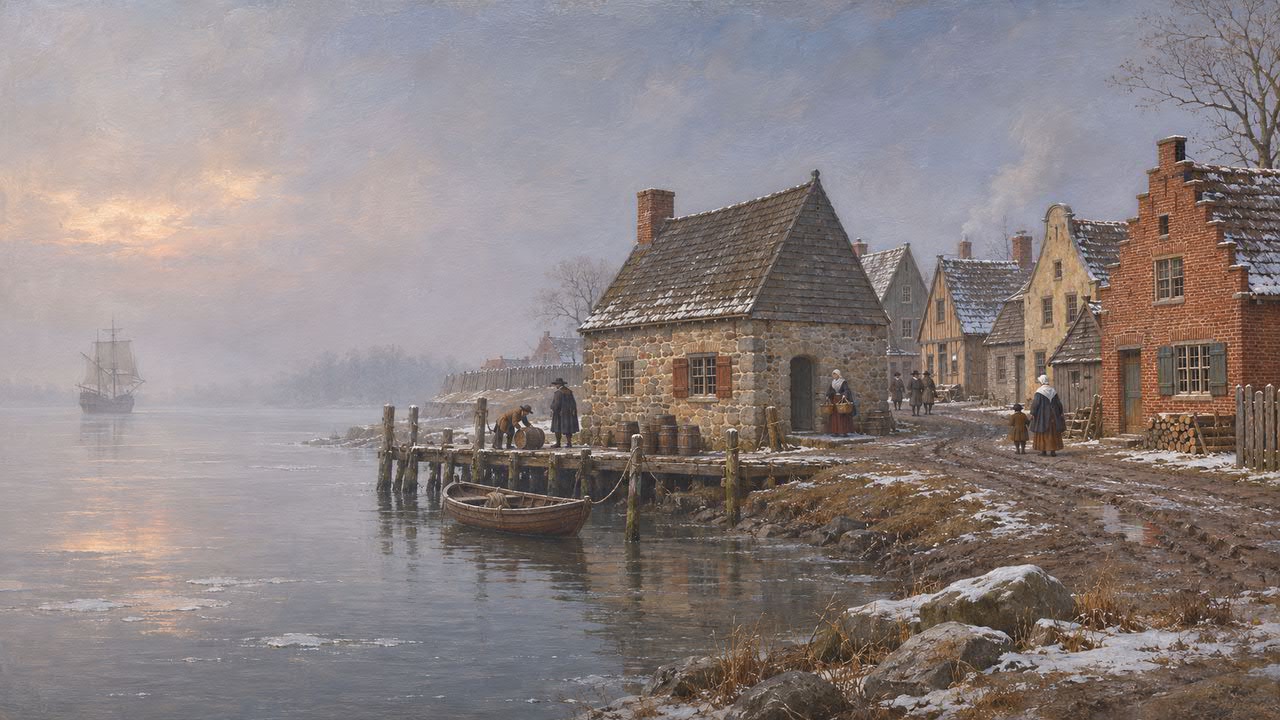
New Netherland: charter, peace and protest
1629–1657
The West India Company offers land privileges to patroons, Mohawk envoys mediate a peace at Fort Amsterdam, and a Dutch city government and an English town's petition reveal how authority worked in the colony.
Chapters
- The Company and the patroons 1 event
In 1629 the West India Company offers hereditary estates to members who bring settlers. It reserves Manhattan for itself.
- Peace at Fort Amsterdam 1 event
Representatives of several Indigenous communities and the Dutch colonial council agree on terms of peace in 1645. Mohawk envoys act as mediators.
- A government for New Amsterdam 1 event
In 1653 Peter Stuyvesant establishes a municipal government for New Amsterdam.
- The Flushing protest 1 event
In 1657 residents of Flushing, an English settlement under Dutch rule, protest a prohibition on receiving Quakers.
Events of the story
This list is the film in text: the same events, in the same order and chapters as on the map. Each event has its sources.
Chapter 1 of 4 · The Company and the patroons 1 event
- West India Company issues the Freedoms and Exemptions for patroons7 June 1629 · North AmericaIn the short version
In 1629 the Dutch West India Company issued the "Freedoms and Exemptions", which offered any member who settled fifty people over the age of fifteen in New Netherland within four years a hereditary estate with its own courts — a patroonship — anywhere except Manhattan, which the Company kept for itself. Only Rensselaerswyck, on the upper Hudson, lasted.
Sources (5)
- Wikipedia (English): Charter of Freedoms and Exemptions
- Van Rensselaer Bowier Manuscripts, ed. and transl. A. J. F. van Laer (1908), p. 154 — Amsterdam Chamber register extract, 7 June 1629: registration by Michiel Pauw
- The Charter of Liberties granted to Patroons and Colonists, A.D. 1629, transl. Abraham Lott Jr. (1769) — Library of Congress scan — pp. [370]–377, arts. I–XXXI and editor's notes
- Historical Society of the New York Courts: The 1629 Charter of Freedoms and Exemptions
- New Netherland Institute: Charter of Freedom and Exemption (1629), from A. J. F. van Laer, Van Rensselaer Bowier Manuscripts, pp. 137–153
Chapter 2 of 4 · Peace at Fort Amsterdam 1 event
- Peace concluded at Fort Amsterdam with the River Indians, with Mohawk mediation30 August 1645 · North AmericaIn the short version
On 30 August 1645, at Fort Amsterdam, sachems of several Native communities from the Hudson valley and New York Bay and Director Willem Kieft's council concluded "a firm and inviolable peace", with Mohawk ambassadors acting as mediators. The treaty ended the fighting known as Kieft's War and set rules for settling future disputes without war.
Sources (4)
- Wikipedia (English): Kieft's War
- Wikipedia (Russian): Война Кифта
- New York State Archives, Dutch colonial council minutes, Series A1809-78, vol. 4, pp. 232–234 (transl. A. J. F. van Laer) — NAHC Encyclopedia
- New York Historical Manuscripts: Dutch. Vol. 4: Council Minutes, 1638–1649 / Transl. A. J. F. van Laer; ed. K. Scott, K. Stryker-Rodda. — Baltimore: Genealogical Publishing Co., 1974.
Chapter 3 of 4 · A government for New Amsterdam 1 event
- Stuyvesant establishes the municipal government of New Amsterdam2 February 1653 · North America
On Candlemas, 2 February 1653, Director-General Peter Stuyvesant issued the document that set up a city government for New Amsterdam, with a schout, two burgomasters and five schepens, as the West India Company's directors had authorised in April 1652. The new body held its first recorded court session four days later.
Chapter 4 of 4 · The Flushing protest 1 event
On 27 December 1657 the magistrates and inhabitants of the English town of Flushing dated a protest to Director-General Stuyvesant against his prohibition on receiving Quakers. They declared that they could not in conscience "lay violent hands upon them" and would let them come and go in the town and its houses.
Sources (5)
- Wikipedia (English): Flushing Remonstrance
- NAHC Encyclopedia: Flushing Remonstrance (New York State Archives, Dutch colonial council minutes, Series A1809, vol. 8, item 625)
- New York State Archives Partnership Trust: Dutch colonial petitions — Flushing Remonstrance
- NAHC Encyclopedia: Minute of the arrest of Tobias Feake for presenting the Flushing Remonstrance (NYSA_A1809-78_V08_0629a)
- New York State Archives Partnership Trust: The Flushing Remonstrance — Outcome
More films

Plymouth and its alliance with the Wampanoag, the expansion of Massachusetts Bay, the Pequot War and the founding rules of Connecticut’s river towns.