
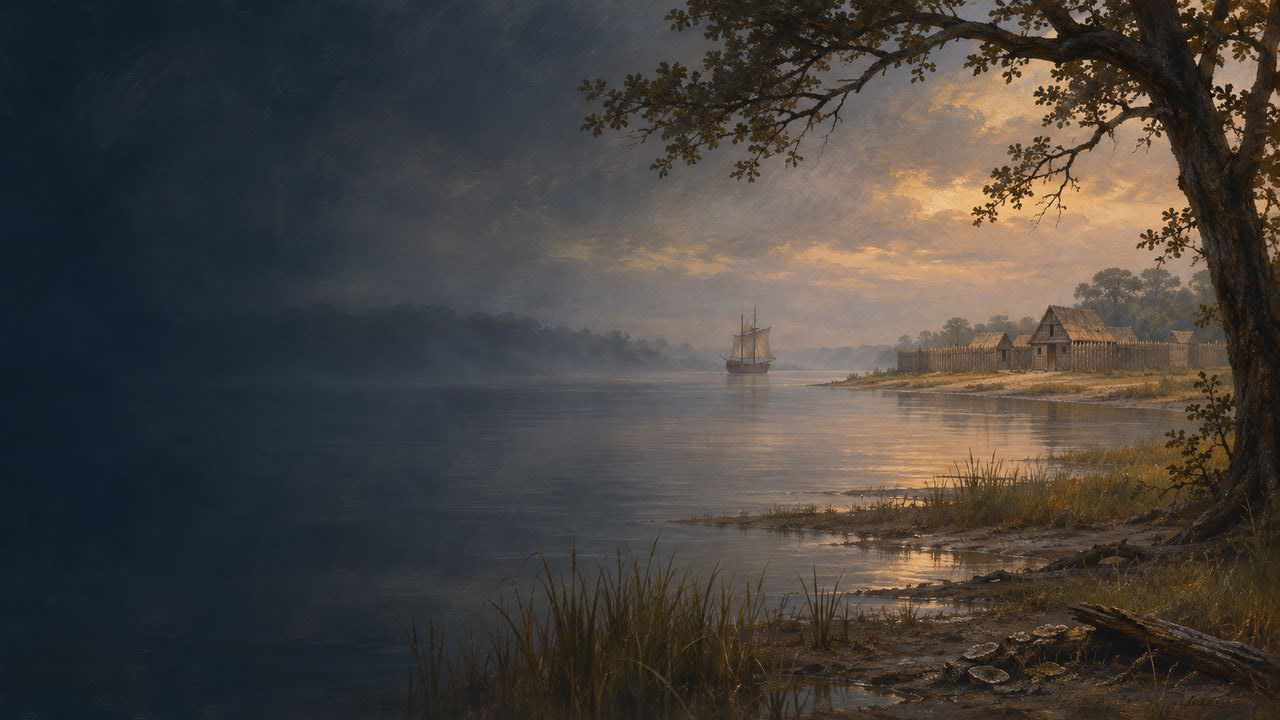
Virginia: from Jamestown to royal rule
1607–1624
An English settlement on the James River, conflict with the Powhatan peoples, the first elected assembly, the arrival of captive Africans, and the end of Company rule.
Chapters
- Settlement and war 2 events
The English founded Jamestown on Paspahegh land. Conflict over food and land escalated into war.
- The assembly and the African captives 2 events
Elected delegates met at Jamestown in July 1619. In August, a privateer brought African captives to Point Comfort.
- Renewed war and royal rule 2 events
The attack of 1622 reopened war. A separate court judgment voided the Company charter in 1624, paving the way for direct royal rule.
Events of the story
This list is the film in text: the same events, in the same order and chapters as on the map. Each event has its sources.
Chapter 1 of 3 · Settlement and war 2 events
On 14 May 1607 (Old Style) about a hundred English men and boys sent by the Virginia Company of London landed on a peninsula in the James River, in the land of the Paspahegh, part of the Powhatan Confederacy, and began building James Fort. Despite famine, disease and war with the Powhatan, Jamestown survived to become the first permanent English settlement in the Americas and remained the capital of Virginia until 1699.
Sources (9)
- Wikipedia (English): Jamestown
- Wikipedia (English): John Smith (explorer)
- Wikipedia (English): Powhatan Confederacy
- Wikipedia (Russian): Джеймстаун (Виргиния)
- Percy G. Observations gathered out of a Discourse of the Plantation of the Southerne Colonie in Virginia by the English, 1606 (Virtual Jamestown)
- National Park Service: A Short History of Jamestown
- Encyclopedia Virginia: The Starving Time
- Kelso W. M. Jamestown: The Buried Truth. — Charlottesville: University of Virginia Press, 2006.
- Wikidata: Q323813
- First Anglo-Powhatan War1609 – April 1614 · North America
Intermittent war between the English colony of Virginia and the peoples of Tsenacommacah led by the paramount chief Wahunsenacawh (Powhatan), from the clashes and blockade of late 1609 to the settlement of spring 1614. English raids destroyed several riverside communities, and the peace that followed Pocahontas's marriage to John Rolfe held until 1622.
Sources (6)
- Wikipedia (English): Anglo-Powhatan Wars
- Wikipedia (Russian): Первая англо-поухатанская война
- Encyclopedia Virginia: First Anglo-Powhatan War (1609–1614), by Brendan Wolfe
- Percy G. A Trewe Relacyon (Virtual Jamestown, from Tyler's Quarterly Historical and Genealogical Magazine III:4) — Nansemond, Ratcliffe, the Starving Time, Kecoughtan, the Paspahegh raid of 9 August 1610
- Hamor R. A True Discourse of the Present Estate of Virginia (1615; Virtual Jamestown) — Pamunkey expedition of March 1614, the marriage, the Chickahominy treaty
- Wikidata: Q6086412
Chapter 2 of 3 · The assembly and the African captives 2 events
- First General Assembly of Virginia meets at Jamestown30 July (9 August) 1619 – 4 (14) August 1619 · North AmericaIn the short version
From 30 July to 4 August 1619 (Old Style) Governor George Yeardley, his council and burgesses elected two from each of the colony's eleven settlements met in the choir of the church at Jamestown — the first elected representative assembly in English America, created under the Virginia Company's instructions of 1618. It spoke for a narrow body of English settler men, not for women, the colony's Native neighbours or the Africans brought to Virginia a few weeks later.
Sources (6)
- Wikipedia (English): House of Burgesses
- Wikipedia (Russian): Палата бюргеров
- Proceedings of the Virginia Assembly, 1619 (Colonial Records of Virginia, Project Gutenberg)
- Encyclopedia Virginia: House of Burgesses, by Matthew S. Gottlieb
- Historic Jamestowne: The 1617 Church — History
- Hatch C. E., Jr. The First Seventeen Years: Virginia, 1607–1624. — Williamsburg: Virginia 350th Anniversary Celebration Corporation, 1957. — P. 22–24.
At the end of August 1619 the English privateer White Lion brought, in John Rolfe's words, "20. and odd" Africans to Point Comfort in Virginia, where the governor bought them for provisions. They were Mbundu people from Angola, seized at sea from a Portuguese slave ship bound for Veracruz. Their arrival, the first recorded of a group of Africans in England's mainland colonies, is seen as the beginning of African American history and of the road to slavery in English North America.
Sources (6)
- Wikipedia (English): First Africans in Virginia
- Wikipedia (English): Jamestown
- Wikipedia (Russian): Джеймстаун (Виргиния)
- National Park Service: African Americans at Jamestown
- Heywood L. M., Thornton J. K. Central Africans, Atlantic Creoles, and the Foundation of the Americas, 1585–1660. — Cambridge: Cambridge University Press, 2007.
- Wikidata: Q69525019
Chapter 3 of 3 · Renewed war and royal rule 2 events
On the morning of Friday 22 March 1622 (Old Style) Powhatan warriors, in an offensive organised by Opechancanough, struck the English plantations along the James River at once, killing 347 colonists by the Virginia Company's count — between a quarter and a third of the settlers, according to modern estimates. The blow opened the Second Anglo-Powhatan War and deepened the crisis of Company rule.
Sources (10)
- Wikipedia (English): Indian massacre of 1622
- Wikipedia (English): Wolstenholme Towne
- Wikipedia (Russian): Джеймстаунская резня
- Waterhouse E. A Declaration of the State of the Colony and Affaires in Virginia. London, 1622 (excerpt, Encyclopedia Virginia)
- Edward Waterhouse: A Declaration of the State of the Colony and Affaires in Virginia (1622), TCP A14803
- Encyclopedia Virginia: Second Anglo-Powhatan War (1622–1632), by James Douglas Rice
- Encyclopedia Virginia: A Declaration of the State of the Colony and Affaires in Virginia (1622), by Martha McCartney
- National Park Service: A Short History of Jamestown
- Hatch C. E., Jr. The First Seventeen Years: Virginia, 1607–1624. — Williamsburg, 1957. — P. 28.
- Wikidata: Q616307
- King's Bench judgment against the Virginia Company: Virginia passes to the Crown24 May (3 June) 1624 · North AmericaIn the short version
On 24 May 1624 (Old Style) the Court of King's Bench gave judgment in quo warranto proceedings against the Virginia Company of London, taking its franchises into the king's hands. Company rule over Virginia ended and the colony came under the Crown, although royal government took practical shape only in the following months.
Sources (6)
- Wikipedia (English): Virginia Company
- Wikipedia (Russian): Лондонская компания
- Craven W. F. The Virginia Company of London, 1606–1624. — Williamsburg: Virginia 350th Anniversary Celebration Corporation, 1957. — P. 55–57 (Project Gutenberg No. 28555).
- Encyclopedia Virginia: Virginia Company of London, by Brendan Wolfe
- National Park Service: A Short History of Jamestown
- Archontology.org: Virginia — polity, 1607–1776 — secondary digest citing Records of the Virginia Company 2:472–475, 4:397–398 and Osgood 3:48–52; primary texts not read directly