
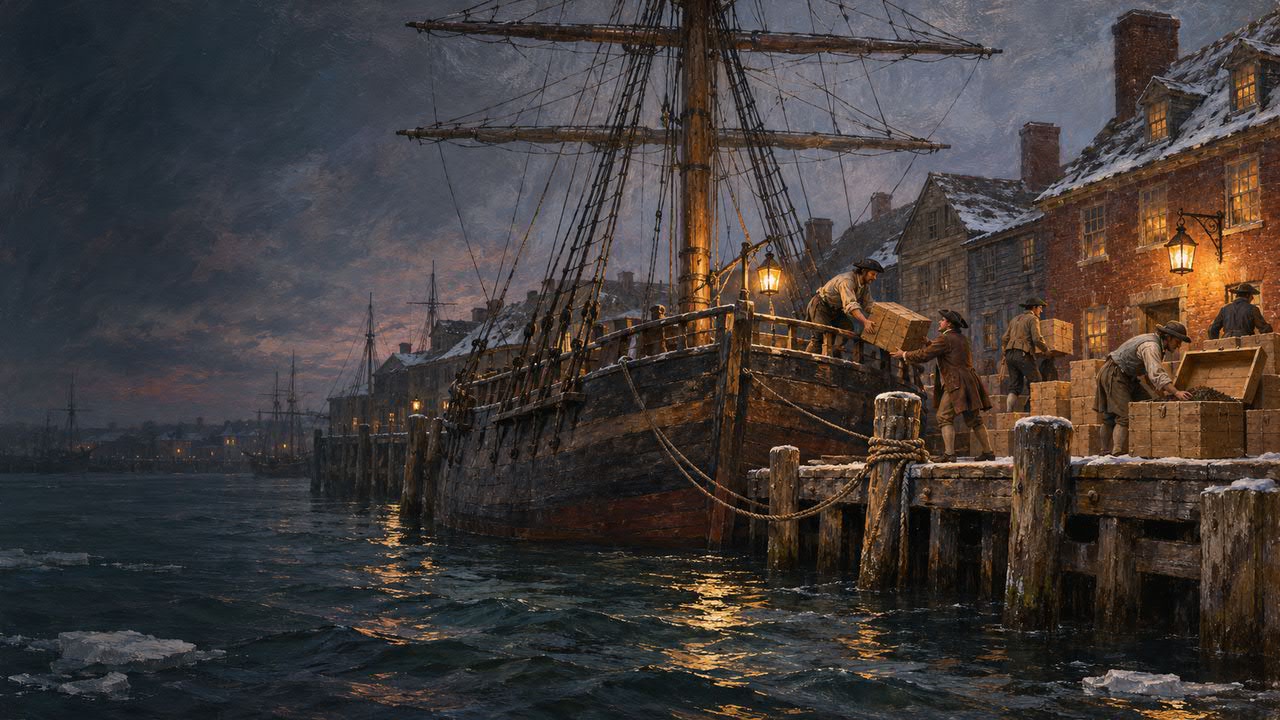
British North America: from proclamation to boycott
1763–1774
From the Crown’s western boundary and Parliament’s new taxes to the contested cession at Fort Stanwix, resistance in Boston and the boycott pledged by twelve colonies in 1774.
Chapters
- A boundary and a new tax 4 events
The Crown sought to limit settlement beyond a provisional boundary. When Parliament imposed stamp duties, delegates from several colonies met to challenge the tax.
- Duties, contested land and Boston 4 events
Parliament imposed new import duties. At Fort Stanwix, the Six Nations ceded land also used or claimed by other Indigenous peoples. In Boston, soldiers shot townspeople in 1770.
- From the tea protest to a common boycott 4 events
After protesters destroyed the East India Company’s tea, Parliament closed the port of Boston to most cargo. Delegates of twelve colonies signed a phased trade boycott in 1774 while still professing loyalty to the king.
Events of the story
This list is the film in text: the same events, in the same order and chapters as on the map. Each event has its sources.
Chapter 1 of 3 · A boundary and a new tax 4 events
On 7 October 1763 George III issued a proclamation that organised the territories Britain had gained by the Treaty of Paris into the new governments of Quebec, East Florida, West Florida and Grenada. It provisionally reserved extensive lands for Native nations, including lands beyond the sources of rivers flowing into the Atlantic from the west and northwest. It restricted land grants and barred private purchases of reserved Native lands where settlement was permitted. The text provided for purchases in the Crown's name and, within proprietary governments, in the proprietors' name.
Sources (7)
- Wikipedia (English): Royal Proclamation of 1763
- Wikipedia (Russian): Королевская прокламация 1763 года
- Crown–Indigenous Relations and Northern Affairs Canada: The Royal Proclamation of 1763 (text derived from the reproduction of Mark Baskett's 1763 printing in Brigham (1911))
- Brigham C. S. (ed.) British Royal Proclamations Relating to America, 1603–1783. — Worcester, Mass., 1911. — P. 212–218 (cited by the CIRNAC transcription; not consulted directly).
- Indigenous Foundations (First Nations Studies Program, University of British Columbia): Royal Proclamation, 1763
- Shanahan D. The Treaty of Niagara and the Belt of the Covenant Chain // Anishinabek News, 31 July 2021
- Wikidata: Q209573
- Stamp Act receives royal assent22 March 1765 · North America
The Stamp Act, which received the royal assent on 22 March 1765, required that from 1 November 1765 newspapers, pamphlets, legal papers, licences, almanacs, playing cards and dice in the American colonies be subject to duties payable in sterling. It was George Grenville's ministry's attempt to make the colonies contribute to the cost of the troops kept in America, imposed by Parliament without the consent of the colonial assemblies.
Sources (5)
- Wikipedia (English): Stamp Act 1765
- Wikipedia (Russian): Гербовый акт (1765)
- The Avalon Project: Great Britain, Parliament — The Stamp Act, March 22, 1765 (from D. Pickering, The Statutes at Large)
- James Wright to the Board of Trade, 15 January and 1 February 1766, C.O. 5/649, ff. 64, 68 (Colonial Records of Georgia, vol. 28, UGA Press transcription)
- Wikidata: Q1335777
- The Stamp Act Congress and its Declaration of Rights and Grievances7–25 October 1765 · North AmericaIn the short version
From 7 to 25 October 1765 twenty-seven delegates from nine colonies met in New York's City Hall. On 19 October they adopted fourteen resolutions, the Declaration of Rights and Grievances, holding that colonists could be taxed only with their own consent through their own assemblies, and then drew up petitions to the King and both Houses of Parliament — while professing loyalty to the Crown and seeking no independence.
Sources (7)
- Wikipedia (English): Stamp Act Congress
- Wikipedia (Russian): Конгресс Гербового акта
- The Avalon Project: Resolutions of the Continental Congress [Stamp Act Congress], October 19, 1765
- Journal of the first Congress of the American Colonies (New York, 1845), pp. 2–3, 25, 27–31 and 41–42
- Architect of the Capitol: New York, 1765 (dates and venue)
- Thomas McKean to John Adams, 20 August 1813 (recollection; University of Virginia Press early-access transcription)
- Wikidata: Q2915080
- Repeal of the Stamp Act and the Declaratory Act18 March 1766 · North America
On 18 March 1766 two acts received royal assent. One repealed the Stamp Act with effect from 1 May 1766, citing harm to Britain's commercial interests; the other, the Declaratory Act, affirmed that Parliament had full power to make laws binding the colonies "in all cases whatsoever" and declared colonial resolutions to the contrary void. The tax was withdrawn, but the constitutional claim the colonists had denied was restated.
Sources (8)
- Wikipedia (English): Declaratory Act
- Wikipedia (English): Stamp Act 1765
- Wikipedia (Russian): Гербовый акт (1765)
- The Avalon Project: Great Britain, Parliament — An Act Repealing the Stamp Act, March 18, 1766 (from D. Pickering, The Statutes at Large)
- The Avalon Project: Great Britain, Parliament — The Declaratory Act, March 18, 1766 (from D. Pickering, The Statutes at Large)
- Statute Law Revision Act 1964, s. 1 and Schedule, printed p. 1222
- Virginia Gazette, 2 May 1766, p. 1 (Encyclopedia Virginia transcription)
- Robin Eagles, The passage of the Declaratory Act, March 1766 (History of Parliament)
Chapter 2 of 3 · Duties, contested land and Boston 4 events
The Revenue Act of 1767 (7 Geo. III c. 46), the central law of the Townshend programme, received the royal assent by commission on 29 June 1767. From 20 November 1767 it levied import duties in the American colonies on glass, red and white lead, painters' colours, paper and tea, and allowed the Crown to spend the proceeds on the administration of justice and civil government in the colonies.
Sources (5)
- Wikipedia (English): Townshend Acts
- Wikipedia (Russian): Законы Таунсенда
- New York Restraining Act (7 Geo. III c. 59), operative clause
- Journal of the House of Lords, vol. 31: June 1767, 21–30, pp. 647–648, 656–660 and 663 (British History Online)
- The Avalon Project: Great Britain, Parliament — The Townshend Act, November 20, 1767 (from D. Pickering, The Statutes at Large)
- Massachusetts Circular Letter11 February 1768 · North America
A letter of 11 February 1768 from the Massachusetts House of Representatives, signed by Speaker Thomas Cushing and addressed to the speakers of the other colonial assemblies. It argued that duties imposed by Parliament for the sole purpose of revenue infringed the colonists' rights because they were not represented there, and invited the other houses to consider constitutional measures and share their views.
Sources (7)
- Wikipedia (English): Massachusetts Circular Letter
- American Battlefield Trust: Massachusetts Circular Letter to the Colonial Legislatures, February 11, 1768
- Massachusetts Historical Society, Collections Online: A Circulatory Letter … February 11, 1768 (Journals of the House of Representatives, Boston: Green and Russell)
- The Papers of Francis Bernard, vol. 4: 1768 (Colonial Society of Massachusetts), No. 608, Hillsborough to Bernard, 22 April 1768, and note 7 on the votes of 21 January and 4 February
- The Correspondence of Thomas Hutchinson, vol. 2 (Colonial Society of Massachusetts): The Refusal to Rescind, letters 324–332
- Encyclopedia of the American Revolution (rev. H. E. Selesky): Massachusetts Circular Letter (Encyclopedia.com)
- Wikidata: Q6784217
- Treaty of Fort Stanwix: the Six Nations' boundary cession5 November 1768 · North AmericaIn the short version
On 5 November 1768, at a congress convened by Sir William Johnson, chiefs of the Six Nations signed a deed ceding to the Crown, for £10,460 7s 3d, lands east and south of a line from the confluence of Canada Creek and Wood Creek near Fort Stanwix to the Ohio and down the Ohio to the mouth of the Cherokee (Tennessee) River. The Six Nations claimed the southern lands as theirs; the Shawnee, who hunted there, did not sign, and the line went beyond both London's instructions and the line just agreed with the Cherokee.
Sources (10)
- Wikipedia (English): Treaty of Fort Stanwix (1768)
- Wikipedia (Russian): Договор в форте Стэнвикс (1768)
- Proceedings at a Treaty held by Sir William Johnson with the Six Nations at Fort Stanwix, 1768, and the deed of 5 November 1768 // Documents Relative to the Colonial History of the State of New-York, vol. VIII (Albany, 1857), pp. 107, 111–137 (Internet Archive OCR text)
- Encyclopedia Virginia: The Treaty of Fort Stanwix (November 5, 1768), transcribed from National Archives, Ratified Indian Treaty 7
- Encyclopedia Virginia: Sir William Johnson to the Earl of Hillsborough, 18 November 1768 (NYCD vol. VIII, pp. 110–111)
- Encyclopedia Virginia: Representation of the Board of Trade to the King upon Sir William Johnson's Treaty with the Indians, 25 April 1769
- Jon Parmenter: The Treaty of Fort Stanwix (1768), chronology for 13 May 1769
- National Park Service: 1768 Boundary Line Treaty of Fort Stanwix
- Williams G. F. Lord Dunmore's War // Encyclopedia Virginia
- Wikidata: Q246501
On the evening of 5 March 1770 British soldiers under Captain Thomas Preston, guarding the Custom House on King Street in Boston against a hostile crowd, fired into it. Three men died on the spot and two more of their wounds over the following days. Boston's patriots called the shooting a massacre, and it became a lasting symbol of the conflict with Britain.
Sources (5)
- Wikipedia (English): Boston Massacre
- Wikipedia (Russian): Бостонская бойня
- Legal Papers of John Adams, vol. 3: Editorial Note on the Boston Massacre trials, pp. 1–34, and Descriptive List of Sources, pp. 34–37 (Massachusetts Historical Society)
- Library of Congress Research Guide: Noteworthy Newspaper Issues — Boston Gazette and Country Journal, 12 March 1770
- Wikidata: Q215687
Chapter 3 of 3 · From the tea protest to a common boycott 4 events
The Tea Act (13 Geo. III c. 44) received the royal assent by commission on 10 May 1773. It refunded in full the British customs duties on tea exported to the American colonies and let the Treasury license the East India Company to ship tea there duty-free from its own warehouses. It imposed no new tax, but the threepenny duty levied in the colonies since 1767 remained.
Sources (6)
- Wikipedia (English): Tea Act
- Journal of the House of Lords, vol. 33: May 1773, 1–10, pp. 634, 638–639 (British History Online)
- Teaching Legal History (University of Nebraska–Lincoln): Tea Act (1773), 13 Geo. 3 c. 44 — transcription from D. Pickering, The Statutes at Large, vol. XXX (Cambridge, 1773)
- The National Archives (UK), Education: Boston Tea Party, Source 2 — the Tea Act (C 65/942)
- The Avalon Project: Great Britain, Parliament — The Townshend Act, November 20, 1767 (tea duty of three pence per pound)
- Wikidata: Q1047538
- Boston Tea Party: the destruction of the East India Company's tea16 December 1773 · North AmericaIn the short version
On the evening of 16 December 1773, after Governor Thomas Hutchinson refused to let the Dartmouth leave Boston without clearing customs, a party of men, many of them disguised, boarded three vessels at Griffin's Wharf and threw the East India Company's tea into the harbour. Contemporary counts range from 340 to 350 chests; Parliament answered with the Boston Port Act.
Sources (5)
- Wikipedia (English): Boston Tea Party
- Wikipedia (Russian): Бостонское чаепитие
- The Correspondence of Thomas Hutchinson (Colonial Society of Massachusetts): The Boston Tea Party — letters 1200 (to Dartmouth, 17 December 1773), 1201 and 1202 (to the East India Company directors, 19 December 1773)
- The National Archives (UK), Education: Boston Tea Party — Sources 3 (Leslie to Barrington, 17 December 1773, WO 40/1), 4 (Boston newspaper, 23 December 1773, CO 5/91) and 5 (Dartmouth to the law officers, February 1774, CO 5/160)
- Wikidata: Q19024
On 31 March 1774 George III, in person in the House of Lords, gave the royal assent to the Boston Port Act (14 Geo. III c. 19), the first of Parliament's punitive measures after the destruction of the tea. From 1 June 1774 it forbade loading and unloading goods in Boston harbour until the town had compensated the East India Company and the King in council judged order restored.
Sources (6)
- Wikipedia (English): Boston Port Act
- Wikipedia (English): Intolerable Acts
- Wikipedia (Russian): Невыносимые законы
- The Avalon Project: Great Britain, Parliament — The Boston Port Act, March 31, 1774
- The London Gazette, no. 11444 (29 March – 2 April 1774), p. 1: Westminster, March 31 (royal assent) and Whitehall, April 2
- Wikidata: Q1612780
- Delegates to the First Continental Congress sign the Continental Association20 October 1774 · North AmericaIn the short version
On 20 October 1774 delegates of twelve colonies at the First Continental Congress in Philadelphia signed the Association, a pledge to stop imports from Britain and Ireland from 1 December 1774, to stop buying or using Company or duty-paid tea immediately and all East India tea from 1 March 1775, and, unless their grievances were redressed, to halt exports to Britain, Ireland and the West Indies from 10 September 1775. It called its signers the King's "most loyal subjects".
Sources (6)
- Wikipedia (English): Continental Association
- Wikipedia (Russian): Континентальная ассоциация
- Wikipedia (Russian): Первый Континентальный конгресс
- The Avalon Project: Journals of the Continental Congress — The Articles of Association, October 20, 1774
- Journals of the Continental Congress, 1774–1789, vol. I: 1774, ed. W. C. Ford (Washington, 1904), pp. 13–14, 30, 43, 51, 62, 73–75, 80–81, 102, 114 (Internet Archive OCR text)
- Wikidata: Q4231641
More films

An English settlement on the James River, conflict with the Powhatan peoples, the first elected assembly, the arrival of captive Africans, and the end of Company rule.

Plymouth and its alliance with the Wampanoag, the expansion of Massachusetts Bay, the Pequot War and the founding rules of Connecticut’s river towns.